Nicolò Pinciroli

Nicolò Pinciroli

(he/him)

Postdoctoral Research Fellow

Politecnico di Milano

Professional Summary

I am a postdoctoral research fellow at Politecnico di Milano, working at the intersection of artificial intelligence and astrophysics. I develop methods that combine spectra, images, time series, and scientific literature to study rare astronomical sources and transient phenomena. My research spans multimodal representation learning, explainable AI, gravitationally lensed transients, and the search for candidate pulsating ultraluminous X-ray sources. I collaborate with INAF's Osservatorio Astronomico di Roma and AstroAI at the Center for Astrophysics | Harvard & Smithsonian. I also work on time-series anomaly detection, predictive maintenance, and language-model applications for energy efficiency, and lead Work Package 3 of the Horizon Europe ENERGENIUS project. I completed my PhD in Information Technology at Politecnico di Milano in June 2026, with the thesis "Making discoveries with multimodal astrophysics."

Education

PhD in Information Technology

2022
2026

Politecnico di Milano

MSc Physics

2023
2026

Linnaeus University

MSc Computer Science and Engineering

2019
2021

Polytechnic University of Milan

MSc Simulation and Visualization

2019
2021

Norwegian University of Science and Technology (NTNU)

BSc Computer Science and Engineering

2016
2019

Polytechnic University of Milan

Interests

Multimodal astrophysics Rare sources and time-domain astronomy Explainable AI Representation learning Time-series anomaly detection Applied AI for energy efficiency
🔭 My research

I work at the intersection of artificial intelligence and astrophysics, with three complementary themes:

Featured publications
Extracting latent representations from X-ray spectra. Classification, regression, and accretion signatures of Chandra sources featured image

Extracting latent representations from X-ray spectra. Classification, regression, and accretion signatures of Chandra sources

The study of X-ray spectra is crucial to understanding the physical nature of astrophysical sources. Machine learning methods can extract compact and informative representations of …

avatar
Nicolò Pinciroli
•
An ultraviolet burst oscillation candidate from the low-mass X-ray binary EXO 0748–676 featured image

An ultraviolet burst oscillation candidate from the low-mass X-ray binary EXO 0748–676

X-ray burst oscillations are quasi-coherent periodic signals at frequencies close to the neutron star spin frequency. They are observed during thermonuclear Type I X-ray bursts …

arianna-miraval-zanon
•
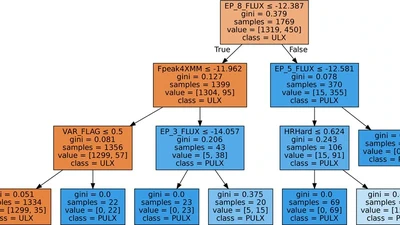
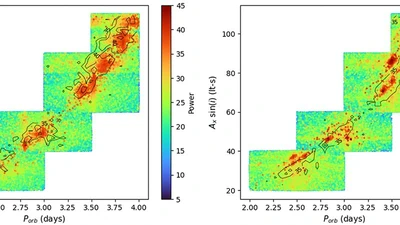
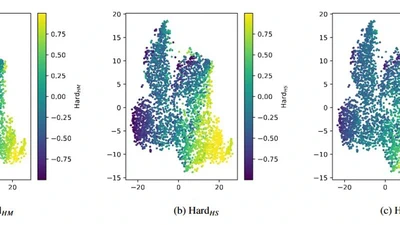
The hunt for new pulsating ultraluminous X-ray sources: A clustering approach featured image

The hunt for new pulsating ultraluminous X-ray sources: A clustering approach

Context. The discovery of fast and variable coherent signals in a handful of ultraluminous X-ray sources (ULXs) points to the presence of super-Eddington accreting neutron stars, …

avatar
Nicolò Pinciroli
•
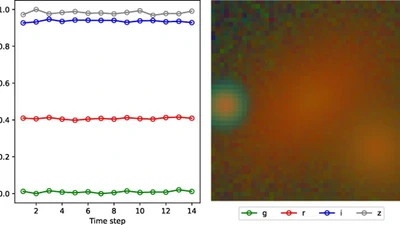
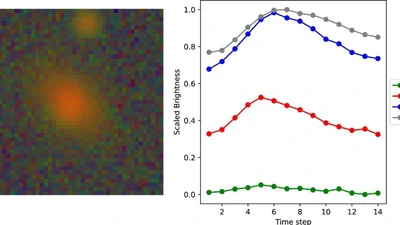
Multimodal multi-output ordinal regression for discovering gravitationally-lensed transients featured image

Multimodal multi-output ordinal regression for discovering gravitationally-lensed transients

Gravitational lenses are caused by massive astronomical objects that distort space-time, bending light. They can distort transient astrophysical events, such as supernovae (SN), …

avatar
Nicolò Pinciroli
•
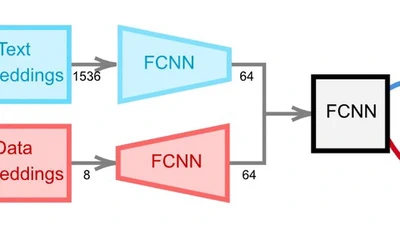
Augmenting X-ray Astronomical Representations with Scientific Knowledge through Contrastive Learning featured image

Augmenting X-ray Astronomical Representations with Scientific Knowledge through Contrastive Learning

Astronomers have produced large multimodal datasets that include images, spectra, and time series, and that encode physical information about the observed objects. In addition, a …

juan-rafael-martinez-galarza
•
A new pulsating neutron star in the Ultraluminous X-ray source NGC 4559 X7? featured image

A new pulsating neutron star in the Ultraluminous X-ray source NGC 4559 X7?

Ultraluminous X-ray sources (ULX) are extragalactic objects with observed X-ray luminosities largely above the Eddington limit for a 10 M⊙ black hole. Currently, it is believed …

fabio-pintore
•
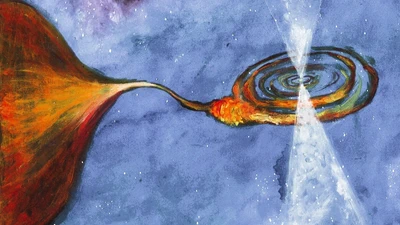
Beyond Accretion Limits: The Rise of Pulsating Gems featured image

Beyond Accretion Limits: The Rise of Pulsating Gems

The discovery of several ultraluminous X-ray sources exhibiting fast and rapidly evolving X-ray pulsations unequivocally associates these sources with accreting neutron stars …

gianluca-israel
•
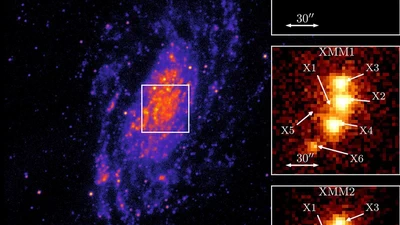
The restless population of bright X-ray sources of NGC 3621 featured image

The restless population of bright X-ray sources of NGC 3621

We report on the multi-year evolution of the population of X-ray sources in the nuclear region of NGC 3621 based on Chandra, XMM-Newton, and Swift observations. Among these, two …

andrea-sacchi
•
DeepGraviLens: a multi-modal architecture for classifying gravitational lensing data featured image

DeepGraviLens: a multi-modal architecture for classifying gravitational lensing data

Gravitational lensing is the relativistic effect generated by massive bodies, which bend the space-time surrounding them. It is a deeply investigated topic in astrophysics and …

avatar
Nicolò Pinciroli
•
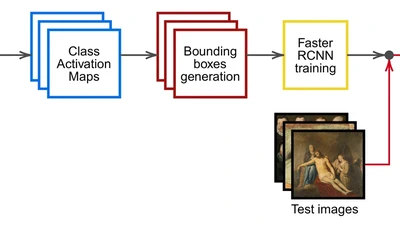
Proposals Generation for Weakly Supervised Object Detection in Artwork Images featured image

Proposals Generation for Weakly Supervised Object Detection in Artwork Images

Object Detection requires many precise annotations, which are available for natural images but not for many non-natural data sets such as artworks data sets. A solution is using …

federico-milani
•
Recent publications
Talks and posters
The hunt for new pulsating ultraluminous X-ray sources: A clustering approach featured image

The hunt for new pulsating ultraluminous X-ray sources: A clustering approach

Presentation on a clustering approach for discovering new pulsating ultraluminous X-ray sources.

avatar
Nicolò Pinciroli
•
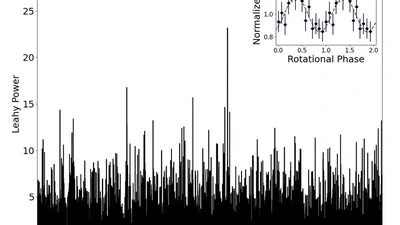
Genetic and evolutionary algorithms for finding pulsations featured image

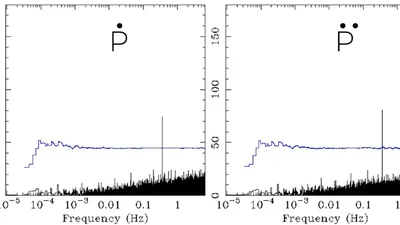
Genetic and evolutionary algorithms for finding pulsations

Presentation on genetic and evolutionary algorithms for finding pulsations in astrophysical data.

avatar
Nicolò Pinciroli
•
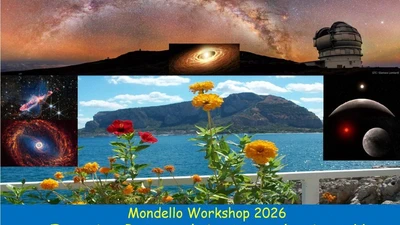
Artificial Intelligence and complex networks in multimodal X-ray astrophysics featured image

Artificial Intelligence and complex networks in multimodal X-ray astrophysics

Invited talk on the use of multimodal data in X-ray astrophysics.

avatar
Nicolò Pinciroli
•
Counting objects with multimodal multi-output ordinal regression featured image

Counting objects with multimodal multi-output ordinal regression

Talk on AI algorithms for gravitational lenses analysis.

avatar
Nicolò Pinciroli
•
eDGL: a multimodal neural network for the study of gravitational lenses featured image

eDGL: a multimodal neural network for the study of gravitational lenses

Talk on classification of gravitational lenses and gravitationally-lensed supernovae

avatar
Nicolò Pinciroli
•
eDGL: a multimodal neural network for the study of gravitational lenses featured image

eDGL: a multimodal neural network for the study of gravitational lenses

Poster on classification of gravitational lenses and gravitationally-lensed supernovae

avatar
Nicolò Pinciroli
•
Artificial Intelligence for Astrophysics featured image

Artificial Intelligence for Astrophysics

Talk on evolutionary algorithms for finding PULXs pulsations.

avatar
Nicolò Pinciroli
•