Invited talk at Workshop 'Optical GEMS in the Quickly Variable Sky'

May 13, 2026·
Nicolò Pinciroli
Nicolò Pinciroli
· 0 min read
Abstract

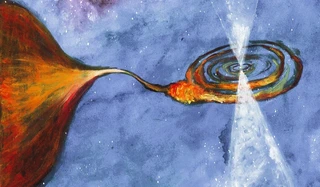
Millisecond pulsars (MSPs) are unique laboratories for probing the Neutron Star (NS) Equation of State (EoS) at supra-nuclear densities. The GEMS project - funded by the Italian MUR under the PRIN 2020 program (PI: Astone) - strategically connected innovative observational strategies across the gravitational wave (CW) and electromagnetic (EM) domains to maximise CW search sensitivity in LIGO-Virgo data.

GEMS leveraged dedicated hardware, like the high-time resolution SiFAP2 optical photometer operated from the Telescopio Nazionale Galileo, to conduct multi-wavelength surveys (radio, optical, X-ray, gamma-ray) of candidate CW sources like bright accreting NSs in Low-Mass X-ray Binaries and MSPs. Major astrophysical results include bringing the total number of detected optical millisecond pulsars to three and identifying promising candidates, advancing the understanding of particle acceleration and optical signal amplification in these systems. The project also pioneered X-ray polarimetry of compact objects in X-ray binaries, contributing to the first X-ray polarisation measurement from an accreting MSP. This critical contribution provides geometric constraints on magnetic fields and emission regions, which are vital for breaking parameter degeneracies in pulse profile modelling to accurately constrain the NS mass and radius, directly informing the EoS. Additionally, fast optical photometry played a role in testing models for Fast Radio Bursts (FRBs) in terms of fast-spinning magnetars.

This workshop will gather experts from multi-wavelength and multi-messenger astrophysics to present and synthesise the GEMS project’s observational and theoretical astrophysical outcomes. The goals are to share validated search algorithms and improved hardware, and collaboratively plan future observing strategies that will push the boundaries of NS fundamental physics with next-generation detectors.

Date
May 13, 2026 12:00 AM — May 15, 2026 12:00 AM
Event
Location

In-person

Monte Porzio Catone,

events
Nicolò Pinciroli
Authors
PhD student in Information Technology
I am a PhD student in Information Technology at Politecnico di Milano. My research focuses on machine learning and data science applications to astrophysics problems, particularly in the search for pulsars and the analysis of gravitational lenses. I have experience in AI, data analysis, and computer vision.