The hunt for new pulsating ultraluminous X-ray sources: A clustering approach

Sep 1, 2025·
Nicolò Pinciroli
Nicolò Pinciroli
,
Roberta Amato
,
Matteo Imbrogno
,
Gianluca Israel
,
Andrea Belfiore
,
Konstantinos Kovlakas
,
Piero Fraternali
,
Mario Pasquato
· 0 min read
PDF
Abstract
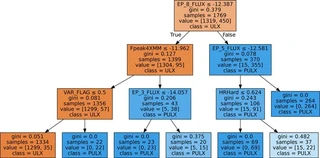
Context. The discovery of fast and variable coherent signals in a handful of ultraluminous X-ray sources (ULXs) points to the presence of super-Eddington accreting neutron stars, drastically altering our understanding of the ULX class. Our capability of discovering pulsations in ULXs is limited, among other issues, by poor statistics. However, catalogues and archives of high-energy missions, such as XMM-Newton, Chandra, and Swift, contain information that is often overlooked, but could otherwise be used to identify new candidate pulsating ULXs (PULXs). The goal of this research is to single out candidate PULXs among ULXs that have not shown pulsations due to an unfavourable combination of factors (low statistics, low pulsed fraction, etc.). We applied an artificial intelligence approach to an updated database of ULXs detected by XMM-Newton. The sample counts 640 sources for a total of ~1800 observations, 95 of which are those of known PULXs. We first used an unsupervised clustering algorithm to sort out sources with similar characteristics into two clusters. Then, the sample of known PULX observations was used to set the separation threshold between the two clusters and to identify the one containing the new candidate PULXs. We found that only a few criteria are needed to assign the membership of an observation to one of the two clusters. Moreover, the best result in terms of the capability of assigning all the known PULXs in one of the two clusters was obtained when the maximum observed flux for each source is included in the clustering algorithm. The cluster of new candidate PULXs counts 85 unique sources for 355 observations, with ~85% of these new candidates having multiple observations. A preliminary timing analysis found no new pulsations for these candidates. This work presents a sample of new candidate PULXs observed by XMM-Newton, the properties of which are similar (in a multidimensional phase space) to those of the known PULXs, despite the absence of pulsations in their light curves. While this result is a clear example of the predictive power of non-traditional, AI-based methods, it also highlights the need for high-statistics observational data to reveal coherent signals from the sources in this sample and thereby validate the robustness of the approach.
Type
Publication
Astronomy and Astrophysics
publications
Nicolò Pinciroli
Authors
Postdoctoral Research Fellow

I am a postdoctoral research fellow at Politecnico di Milano, working at the intersection of artificial intelligence and astrophysics. I develop methods that combine spectra, images, time series, and scientific literature to study rare astronomical sources and transient phenomena. My research spans multimodal representation learning, explainable AI, gravitationally lensed transients, and the search for candidate pulsating ultraluminous X-ray sources.

I collaborate with INAF’s Osservatorio Astronomico di Roma and AstroAI at the Center for Astrophysics | Harvard & Smithsonian. I also work on time-series anomaly detection, predictive maintenance, and language-model applications for energy efficiency, and lead Work Package 3 of the Horizon Europe ENERGENIUS project.

I completed my PhD in Information Technology at Politecnico di Milano in June 2026, with the thesis “Making discoveries with multimodal astrophysics.”