Proposals Generation for Weakly Supervised Object Detection in Artwork Images

Aug 6, 2022·
Federico Milani
Nicolò Pinciroli
Nicolò Pinciroli
,
Piero Fraternali
· 0 min read
PDF
Abstract
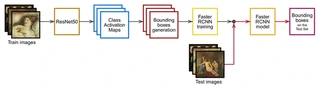
Object Detection requires many precise annotations, which are available for natural images but not for many non-natural data sets such as artworks data sets. A solution is using Weakly Supervised Object Detection (WSOD) techniques that learn accurate object localization from image-level labels. Studies have demonstrated that state-of-the-art end-to-end architectures may not be suitable for domains in which images or classes sensibly differ from those used to pre-train networks. This paper presents a novel two-stage Weakly Supervised Object Detection approach for obtaining accurate bounding boxes on non-natural data sets. The proposed method exploits existing classification knowledge to generate pseudo-ground truth bounding boxes from Class Activation Maps (CAMs). The automatically generated annotations are used to train a robust Faster R-CNN object detector. Quantitative and qualitative analysis shows that bounding boxes generated from CAMs can compensate for the lack of manually annotated ground truth (GT) and that an object detector, trained with such pseudo-GT, surpasses end-to-end WSOD state-of-the-art methods on ArtDL 2.0 (≈41.5% mAP) and IconArt (≈17% mAP), two artworks data sets. The proposed solution is a step towards the computer-aided study of non-natural images and opens the way to more advanced tasks, e.g., automatic artwork image captioning for digital archive applications.
Type
Publication
Journal of Imaging, 8(8)
publications
Nicolò Pinciroli
Authors
Postdoctoral Research Fellow

I am a postdoctoral research fellow at Politecnico di Milano, working at the intersection of artificial intelligence and astrophysics. I develop methods that combine spectra, images, time series, and scientific literature to study rare astronomical sources and transient phenomena. My research spans multimodal representation learning, explainable AI, gravitationally lensed transients, and the search for candidate pulsating ultraluminous X-ray sources.

I collaborate with INAF’s Osservatorio Astronomico di Roma and AstroAI at the Center for Astrophysics | Harvard & Smithsonian. I also work on time-series anomaly detection, predictive maintenance, and language-model applications for energy efficiency, and lead Work Package 3 of the Horizon Europe ENERGENIUS project.

I completed my PhD in Information Technology at Politecnico di Milano in June 2026, with the thesis “Making discoveries with multimodal astrophysics.”