The restless population of bright X-ray sources of NGC 3621

Jun 27, 2024·
Andrea Sacchi
,
Matteo Imbrogno
,
Sara Elisa Motta
,
Paolo Esposito
,
Gian Luca Israel
Nicolò Pinciroli
Nicolò Pinciroli
,
Andrea De Luca
,
Martino Marelli
,
Fabio Pintore
,
Guillermo Andres Rodríguez Castillo
,
Ruben Salvaterra
,
Andrea Tiengo
· 0 min read
PDF
Abstract
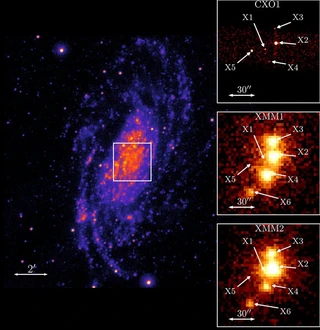
We report on the multi-year evolution of the population of X-ray sources in the nuclear region of NGC 3621 based on Chandra, XMM-Newton, and Swift observations. Among these, two sources, X1 and X5, after their first detection in 2008, seem to have faded below the detectability threshold, a most interesting fact as X1 is associated with the active galactic nucleus (AGN) of the galaxy. Two other sources, X3 and X6, are presented for the first time, the former showing a peculiar short-term variability in the latest available dataset, suggesting an egress from eclipse, and hence belonging to the handful of known eclipsing ultra-luminous X-ray sources. One source, X4, previously known for its heartbeat (i.e. a characteristic modulation in its signal with a period of ≈1 h), shows a steady behaviour in the latest observation. Finally, the brightest X-ray source in NGC 3621, here labelled X2, shows steady levels of flux across all the available datasets, but a change in its spectral shape, reminiscent of the behaviours of Galactic disc-fed X-ray binaries.
Type
Publication
Astronomy and Astrophysics
publications
Nicolò Pinciroli
Authors
Postdoctoral Research Fellow

I am a postdoctoral research fellow at Politecnico di Milano, working at the intersection of artificial intelligence and astrophysics. I develop methods that combine spectra, images, time series, and scientific literature to study rare astronomical sources and transient phenomena. My research spans multimodal representation learning, explainable AI, gravitationally lensed transients, and the search for candidate pulsating ultraluminous X-ray sources.

I collaborate with INAF’s Osservatorio Astronomico di Roma and AstroAI at the Center for Astrophysics | Harvard & Smithsonian. I also work on time-series anomaly detection, predictive maintenance, and language-model applications for energy efficiency, and lead Work Package 3 of the Horizon Europe ENERGENIUS project.

I completed my PhD in Information Technology at Politecnico di Milano in June 2026, with the thesis “Making discoveries with multimodal astrophysics.”