On the visualization of semantic-based mappings

Jul 20, 2021·
Nicolò Pinciroli
Nicolò Pinciroli
,
Mario Sacaj
,
Mersedeh Sadeghi
,
Safia Kalwar
,
Matteo Giovanni Rossi
· 0 min read
PDF
Abstract
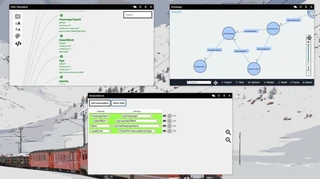
The popularity of the semantic web in many domains, such as transportation, has led to an ever-increasing development of standards, vocabularies, and ontologies, which generates problems of heterogeneity and lack of interoperability. To address this issue, a large body of research focused on providing various mapping tools and techniques to translate data from one standard to another to foster smooth communication among them. While valuable advancements in mapping techniques have been achieved so far, the explainability and usability of such tools have been overlooked. Since explainability of software is being recognized as a crucial non-functional requirement for complex systems, the development of self-explaining and user-friendly graphical interfaces is becoming a pressing need. In this paper we present S2SMaT, our contribution to the problem of visualization of mappings. The tool helps users easily navigate the structure of standards, understand the suggested mappings between their terms, and in general more easily interact with the system.
Type
Publication
Proceedings of the 3rd International Workshop Semantics And The Web For Transport co-located with Semantics Conference (SEMANTiCS 2021)
publications
Nicolò Pinciroli
Authors
Postdoctoral Research Fellow

I am a postdoctoral research fellow at Politecnico di Milano, working at the intersection of artificial intelligence and astrophysics. I develop methods that combine spectra, images, time series, and scientific literature to study rare astronomical sources and transient phenomena. My research spans multimodal representation learning, explainable AI, gravitationally lensed transients, and the search for candidate pulsating ultraluminous X-ray sources.

I collaborate with INAF’s Osservatorio Astronomico di Roma and AstroAI at the Center for Astrophysics | Harvard & Smithsonian. I also work on time-series anomaly detection, predictive maintenance, and language-model applications for energy efficiency, and lead Work Package 3 of the Horizon Europe ENERGENIUS project.

I completed my PhD in Information Technology at Politecnico di Milano in June 2026, with the thesis “Making discoveries with multimodal astrophysics.”